Tuesday, May 05, 2009

Kleur als remedie-Colour as a remedy

Een miezerige dag als vandaag kan best wel wat kleur gebruiken. In de tuin met verfplanten in het MIAT in Gent staat Isatis tinctoria, de wede, in bloei, de plant die zo belangrijk was voor het bekomen van blauw geverfde stof vooraleer indigo werd ingevoerd uit India in de 16e eeuw.
Zou er ergens breigaren te vinden zijn, gekleurd met wede? Jazeker, bijvoorbeeld bij het Engelse Renaissance Dyeing...

This drizzly weather asks for some colour. In the garden with dye plants of the Museum for Industrial Archeology and Textile in Ghent, Isatis tinctoria, the woad, was in flower. This plant was very important to obtain blue fabric, before the import of indigo from India in the 16th century. I am wondering if there exists knitting yarn dyed with woad? Of course, at Renaissance Dyeing for example...


En nu de beloofde kleurexplosie: de pioenen uit de tuin, één week terug, in hun outfit van
tafzijde:
And here comes the splash of colour: the way the peonies in my garden looked last week, with a strong resemblance to silk
taffeta dresses:

Monday, May 04, 2009

Meiklokjessjaal-Lily of the valley shawl-Nancy Bush

Mijn tante uit Brugge is een fervente handwerkster en ik heb dan ook veel van haar geleerd. Aan Estlands kantbreien wou ze zich ook wel eens wagen toen ze het book Knitted Lace of Estonia door Nancy Bush had ingekeken. In het begin ging het met "nupps en downs", het blokken was een primeur maar het resultaat mag er zijn:
My aunt from Bruges is well versed into needle arts and I learned a lot from her. Not being on the internet herself, I wanted to show her first Estonian lace shawl, a pattern from Nancy Bush.
Learning the technique went with "nupps and downs", blocking a shawl was also something new but the outcome was lovely:


Het gebruikte garen is dat van het oorspronkelijke patroon, 100% cashmere 2ply van Jojoland, gekocht bij Kaleidoscope yarns:
The yarn she used is the same as in the pattern, a 100% cashmere 2ply from Jojoland, bought at Kaleidoscope yarns:


Ongelofelijk zacht...
Incredibly soft...

Sunday, May 03, 2009

Een dagje in de Zwalmstreek-A day in the countryside south of Ghent

Twee dagen na de workshop bezocht ik in de Zwalmstreek het Provinciaal Archeologisch Museum in Velzeke, waar een heel mooie tentoonstelling over Romeins glas loopt:
Two days after the workshop I went to an exhibition about Roman glass in the Archeological Museum of Velzeke:


Er was ook een opstelling met een schilderij van
Henk Helmantel, de bekende Nederlandse schilder van stillevens, waarbij ook het glas te zien was waarnaar het geschilderd was:
There was also a painting by Henk Helmantel, the famous Dutch painter of still-life; as a trompe-l'oeil they placed at the bottom the Roman glass he used as a subject:


De
Terbiestmolen, één van de watermolens uit de Zwalmstreek, was een pittoreske plaats om te lunchen:
The Terbiestmolen, one of several water-mills in the surroundings and a nice place to lunch:

In het restaurant is een oorspronkelijke maalinstallatie aanwezig:
Inside the restaurant there is an authentic mill:

Buiten was alles in lentetooi:
Outside Spring in its full glory:

Appelbloesem:
Apple-blossom:

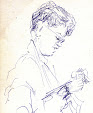
In de namiddag ging ik kijken naar de schetsen van Emiel Claus in het
Museum van Deinze en de Leiestreek. Ik zag er een "Handwerkende vrouw":
In the afternoon I visited the Museum of Fine Arts in Deinze for an exhibition with the sketches of Emiel Claus, where I saw this "Woman doing needlework":

Saturday, May 02, 2009

Workshop Estlandse breitechnieken-Estonian knitting door/by the Dutch Knitters

Twee weken geleden bracht ik de dag door in 't Wolwinkeltje in Leuven, voor een workshop in Estlandse breitechnieken gegeven door Carla en Hilly van de Dutch Knitters. Hier toont Carla haar Greta Garbo sjaal, terwijl Hilly een driehoekige sjaal in meiklokjespatroon om heeft:
Two weeks ago I spent the day in 't Wolwinkeltje in Leuven, a Flemish yarn store for a workshop in Estonian knitting techniques by Carla en Hilly from the Dutch knitters. Here Carla is showing her Greta Garbo shawl while Hilly is wearing the triangular summer shawl by Nancy Bush:


Wanten om te bewonderen en heerlijk om dragen:

Mittens as lovely to see as to wear:

's Morgens leerden we meer tradititonele breitechnieken:
In the morning we learned more traditional knitting techniques:

De namiddag was voorbehouden voor kantbreiwerk, met nupps in alle formaten:
In the afternoon there was lace knitting, with nupps in all sizes:


En als toetje kregen we een leuke
kabel te verwerken, die als effect wel iets weg heeft van bezemsteelbreien:
At the end we had to tackle an original Estonian cable, resembling a bit the effect of broomstick lace:


Er werd intensief gebreid:
We knitted intensively:
maar tussendoor werd er gelachen en werden er contacten gelegd. Dominique was er ook, naast Breimuisline, Flemishflower en KarenNZ uit Nieuw-Zeeland, die nu in Brussel verblijft:
but there was also room for fun and socializing. Dominique was there, and also BreimuisLine, Flemishflower and KarenNZ from New Zealand, now residing in Brussels:

Na de workshop ben ik aan de verleiding bezweken. Kantgaren van
Marianne Isager, 100% alpaca:
After the workshop I could not resist temptation. Laceweight yarn from Marianne Isager, 100% alpaca:


En enkele boeken die al op mijn verlanglijstje stonden:
And some books that were on my wish list:

Een heel fijne en inspirerende dag is het geworden...
It was a truly inspiring and pleasant day...

Friday, May 01, 2009

Gehaakt zomersjaaltje in Ganpi Abaka-Crocheted Summer Scarf in Ganpi Abaka

Tijdens de laatste koopjesperiode kocht ik bij Stoffenidee in Gent enkele strengen Ganpi Abaka Teipu van Noro. Dit fijne bandjesgaren bevat de bast van Wikstroemia sikokiana, een Japanse boom die sedert eeuwen gebruikt wordt om kwaliteitspapier te maken. Het voelt inderdaad papierachtig aan en geeft veel structuur. Na het wassen wordt het een stuk zachter zonder zijn vorm te verliezen, heel speciaal. Het gebruikte haakpatroon is afkomstig uit een Japans boek uitgegeven door Ondorisha, met als ISBN 4-277-17188-5. Gisteren vernam ik het droeve nieuws dat deze uitgeverij het faillissement zou aangevraagd hebben...

During the latest sales period I bought at Stoffenidee in Ghent some skeins of Noro Ganpi Abaka Teipu. This fine ribbon yarn contains the bark of Wikstroemia sikokiana, a Japanese tree used for centuries to produce high quality paper. It has a papery feel indeed and gives a lot of structure when unblocked. After washing it gets a lot softer without loosing its shape, quite special.
The crochet pattern I used comes out of the Japanese magazine with ISBN 4-277-17188-5, published by Ondorisha. Yesterday I learned that this publishing company would have filed for bankruptcy which would be very sad indeed...

Dit grafisch patroon is fascinerend omdat het er anders uitziet naar gelang de richting vanwaar men het bekijkt:
This graphic pattern is fascinating because it changes according to the point of view:


Het sjaaltje werd met veel aandacht en vol energie opgespannen:
Once again I had an enthusiast blocker, full of attention and performing very energetic stretching:


Het resultaat is een fris zomersjaaltje:
It resulted in a crisp summer scarf: